

-
-
Industry
-
-
-

-
Career Development
-
-
-



Everything you need to know about setting up and succeeding in Singapore
A new index shows Singapore ranks among the top 105 cities easiest to undergo AI transformation.
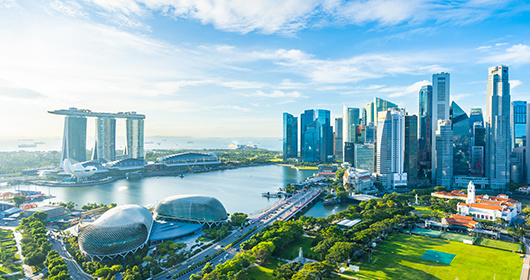
According to a new index assessing the AI readiness of 105 cities globally, Singapore is best prepared for the next wave of technological disruption brought about by artificial intelligence (AI).

Technologies that allow machines to learn from massive amounts of data promise new conveniences for modern life and economic benefits. However, job displacement risks, exposure of people's privacy, and inequalities may persist due to AI being fed biased data, with cities at various stages of preparing for this new future.
To determine how global cities are preparing for this disruptive future, the New York-based research firm Oliver Wyman Forum released its inaugural Global City AI Readiness Index on Thursday (September 26, 2019), scoring 31 indicators, covering four areas: vision, enabling capabilities, asset base, and growth trajectory.
Singapore’s strong performance in the vision category earned it the highest overall score of 75.8, which measures the existence of plans to adapt to technological change and plans to upgrade infrastructure such as worker skills and mobile networks.
Singapore scores highly on its foresight; the research firm cites the whole-of-government approach to how AI can be deployed across society and the establishment of a high-level steering committee for this purpose. Singapore is one of the few governments globally that developed an AI governance framework to address ethical dilemmas.
At the annual World Economic Forum meeting in Davos this January, Singapore announced a framework for the ethical use of AI.
The Singaporean government will also set up an inter-agency taskforce to explore how the country can develop its AI capabilities and become a trusted global hub for testing and deploying AI solutions.
Singapore also performed well in the asset base category, which assesses the number of intellectual property rights, labor productivity, tech talent, venture capital investment, and the education level of the population.
Specifically, under the National Research Foundation’s five-year fund, a total of S$900 million has been allocated for research and development in AI, robotics, and supercomputing which will continue until 2021. Ongoing AI projects include systems that identify patients susceptible to chronic diseases such as diabetes., robots for performing critical tasks, and wearable sensors that allow for early intervention in heart failure.
Other recent developments that favor Singapore include its data protection law and cybersecurity strategy that maximizes the impact of digital technologies on the economy.
Other top-10 cities are London (75.6), New York (72.7), San Francisco (71.9), Paris (71.0), Stockholm (70.4), Amsterdam (68.6), Boston (68.5), Berlin (67.3), and Sydney (67.3).
In China, cities known for their widespread adoption of AI technologies did not appear in the overall top 10 in a list where they scored relatively low in most categories.
However, the Chinese cities of Shenzhen, Beijing, Guangzhou, Shanghai, and Hangzhou scored highest in the growth trajectory category, which measures the speed of development of technical infrastructure, the efficiency of city management, and the scale of venture capital investment.
For one, law enforcement in Beijing and Shanghai has already used gait and facial recognition technologies to help identify individuals, even when their faces are covered.
Meanwhile, Shenzhen is home to telecom equipment giant Huawei, which is a world leader in the development of 5G technology, while Hangzhou is home to global e-commerce giant Alibaba.
Alibaba’s AI technology is also automating traffic management in Hangzhou, such as changing traffic signals for ambulances.
China’s high tolerance for privacy-invasive technologies led to the introduction of citizen surveillance systems employing facial and gait recognition technologies. This, he argues, encouraged innovation and “created a strong channel for Chinese cities to deploy AI, giving them a stronger growth trajectory.”


Singapore FOZL Group for
Singaporean accounting and corporate regulatory agency licensed business advisory firm
Singapore company registration annual audit accounting
Trademark registration internal audit business consulting
Relevant Knowledge
Singapore Office:6 Raffles Quay, #14-02——#14-07, Singapore 048580
Tel:+65 6717 0088
E-mail:marketing51@fozl.sg
Follow Us
Singapore 201101725E Germany DEB8536.HRB730998 Malaysia 202201006785 (1452482-W) China